Grooves cut into your shoulders by lunchtime and a band that creeps up your back aren’t signs you need a ‘special’ bra. They’re signs the band is too big and the straps are carrying weight they were never meant to.
What to Actually Look For
- Wide, cushioned straps: At least an inch wide, to spread weight across a bigger area of the shoulder instead of digging into one line.
- Full-coverage cups with side support panels: Extra fabric along the sides prevents spillage and adds shape without relying on the wire alone.
- A sturdy, non-stretch band: This is doing most of the actual support work, not the straps.
- 3+ columns of hook-and-eye closures: More adjustment room as the band naturally stretches with wear over time.
Get the Sizing Right First
One of the most common fit mistakes on a fuller bust is wearing a band that’s too big paired with a cup that’s too small. Both push the workload onto thin straps. Run your real numbers with the Plus Size Calculator.
The Most Common Mistake
Assuming a smaller band with a bigger cup number is ‘more supportive.’ A properly snug, smaller band paired with the correspondingly bigger cup almost always feels more secure.
Band Width Does the Real Work
At larger cup sizes, a wide, non-stretch band (often 1.5 inches or more) distributes weight across your ribcage instead of letting the straps carry it. Narrow bands and larger cups are a common mismatch that causes shoulder grooves and back pain regardless of the cup being “correct.”
Check the Center Gore Along With the Cup Edge
The center gore (the panel between the cups) should sit flat against your sternum. If it floats away from your body, the cup is too small for your actual volume, even if the outer edge of the cup looks like it fits.
Band Width and Load Distribution
A wider band spreads the weight of larger cup volume across more of the ribcage, reducing the pressure concentrated at any single point. This is why band width often matters more at this range than at smaller sizes, where a narrower band is less likely to cause discomfort.
Common Construction Red Flags
Single-layer, unlined cups with no seaming tend to struggle at larger volumes, often wrinkling or losing shape by midday. Thin, unpadded straps that aren’t reinforced with wider stitching or cushioning are another common weak point. Multi-panel seamed cups and wider, reinforced straps are generally more reliable indicators of a bra actually built for this range.
Why Wire Gauge and Band Width Matter More Here
At larger cup volumes, a thicker underwire gauge and a wider band aren’t cosmetic choices. They’re structural necessities for actually distributing weight without digging in or bending out of shape over a day of wear. Thinner wire and narrower bands, common in styles designed around smaller cup ranges, tend to fail faster and less comfortably at this range.
Common Shopping Mistake at This Range
Assuming a style needs to be plain or purely functional to provide real support is a common and unnecessary compromise. Construction quality (wire gauge, seam placement, band width) and design variety are independent of each other, and plenty of well-engineered options exist beyond the most basic full-coverage shape.
Merged Fit Note: Supportive Bras
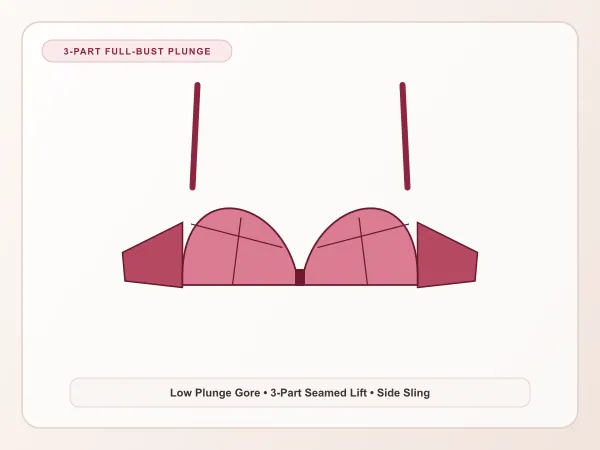
Full-support bras for large busts and supportive bras use three-part seamed cups, side-support slings, and firm U-back wings to lift heavy tissue off your shoulders.
Best Support Bra
Lightly lined spacer-foam cups allow airflow through microscopic fabric channels while preventing nipple show-through under fine knit shirts.