By Bra Fit Educator Claire Bennett
BraSizeCalculatorHonest Bra Fit Guides
Bra Fit Troubleshooting

Side Boob Spillage: Why It Happens and How to Fix It

Spillage at the side of the cup, near the underarm, usually means the cup is too narrow or too small for a fuller side profile.

By Claire BennettReviewed by Sizing & Chart Review Desk3 min read
Direct Fit Answer

Spillage at the side of the cup, near the underarm, usually means the cup is too narrow or too small for a fuller side profile.

Side Boob Spillage: Why It Happens and How to Fix It: summary card with the main sections of this guide
Fit Symptom & Fix
Spillage at the side of the cup, near the underarm, usually means the cup is too narrow or too small for a fuller side profile.Bra-SizeCalculator.com Guide

Want the exact size adjustment for your current bra?

Enter your current bra size in our tape-free Smart Fit Diagnostic to see which size to try next.

Check My Size

Why This Happens

Some bra styles cut the side panel narrow to create a specific silhouette, which works fine for narrower profiles but pushes fuller side tissue outward on others.

This can also simply be an undersized cup, which pushes tissue out wherever there’s the least resistance, often the side, since it’s the path of least resistance for many shapes.

How to Confirm the Cause

  • Spillage happens mainly under the arm, not at the top of the cup.
  • It’s worse in narrower-cut styles and better in full-coverage styles, pointing to a style-shape mismatch.
  • The band fits well, isolating this to the cup, not the band.

The Fix

Try a cup size up first, in the same band, as the direct fix for volume.

If spillage persists in the right size, look for styles with wider side panels or ‘side support’ features, built specifically to contain fuller side profiles.

When It Might Be Something Else

If spillage is worse on one side only, that’s usually natural asymmetry, which is best handled by fitting to your larger side.

The 30-Second Self-Check

Raise your arm to the side and check the area right next to the cup, toward your armpit. If tissue visibly spills past the side edge of the cup or wing, the cup or side panel is too narrow for your shape at that point.

A Wing/Side-Panel Issue, Not Always a Cup-Size Issue

This is frequently a style issue rather than a size issue. Some styles have a narrow side panel that doesn’t extend far enough around your side, regardless of cup letter. A style with a wider wing or side-support panel, in the same size, often solves it without any resizing at all.

If spillage happens at the side even in wide-wing styles, sizing the cup up (via a sister size) is the more likely fix.

Side Spillage Isn’t Always About Cup Size

A style with a narrow side panel, built for a more tapered shape, can cause this exact issue even at a technically correct cup size. Switching to a full-coverage or wider side-panel style is sometimes the actual fix, not a bigger cup.

When It Points to Band Size Instead

If side spillage improves noticeably when you try a snugger band in the same cup letter, the band (not the cup) may be the real issue: a loose band lets the whole bra sit lower and wider than it should, pushing side panels outward along with it.

A Quick Self-Check

Check the side panel coverage specifically (rather than the front cup). If tissue overflows at the outer edge near your armpit specifically, rather than the top of the cup, that points to a band that’s too wide for your chest width, pushing the cup’s side seam inward past where your actual tissue extends.

How to Tell This Apart From Similar Problems

This is a more specific version of general cup-spillage. Side-boob-spillage points specifically to band width and side-panel coverage as the likely culprit, whereas top overflow (plain cup-spillage) more often points to overall cup volume being too small.

What to Try First

Try the same cup size on a narrower band first. This alone resolves side spillage for many people without needing any cup-size change at all.

A Realistic Example

Someone whose ribcage narrows more than average toward the sides often experiences this specifically in balconette styles that assume a more standard side taper. Switching to a full-coverage style with more side panel fabric, in the same size, frequently resolves it without any size change.

Bras That Help Fix This Fit Issue

#1
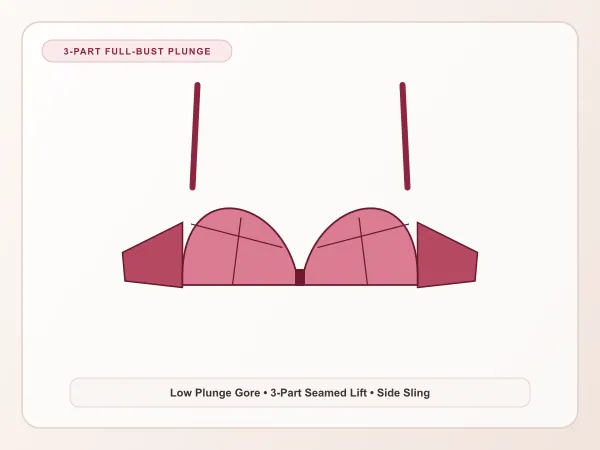
Rosewood three-part seamed full-bust plunge underwire bra diagram showing low center gore and side slingTop Pick for Large BustUnderwire
ProjectedPendulousWide Root
ElomiPlus-Size & Deep Cup Engineering (DD–K UK)

Elomi Women's Matilda 3-Part Full-Bust Underwire Plunge Bra

Bands 32–46

A popular UK full-bust plunge with three-part sheer mesh cups, an inner side-support panel, and a built-in J-hook clip on the straps.

Claire's Fit Note: Elomi uses UK sizing. If our calculator gives you US 36I, order UK 36G.
Why We Like It:
  • Low center gore sits flat even in H, J, and K cups
  • Side-support panel keeps tissue centered and out of your underarms
  • Light mesh fabric breathes well in hot weather
Keep in Mind:
  • Uses UK cup letters (check your UK size in our calculator first)
  • Stitched trim can show slightly under thin white tees
Check size availability and return options on Amazon
View on Amazon
#2
Top Pick for Large BustUnderwire
ProjectedFull on BottomSmall Band
PanacheSmall Bands with Full Cups (28–40, D–J UK)

Panache Women's Envy Full Cup Underwire Bra

Bands 28–40

A seamed full-cup bra from a UK specialist brand, made for the small-band, big-cup sizes most department stores skip.

Fit Note: Panache uses UK cup letters. The calculator links you to your UK size automatically.
Why We Like It:
  • Stocks 28 and 30 bands in deep cups
  • Seamed cups give round, forward shape
  • Firm band carries most of the support
Keep in Mind:
  • UK sizing, so check your UK size first
  • Seams can show under very thin tops
Check size availability and return options on Amazon
View on Amazon

Frequently Asked Questions

Yes. Many brands make styles with wider side panels specifically for fuller side profiles.

Related Fit Problems

About the FitterChecked Across 7 Sizing Systems
Updated: November 2026
Written & Reviewed ByClaire Bennett• Bra Fit Educator & Founder

Claire Bennett spent over 10 years fitting women in specialty lingerie shops before starting Bra-SizeCalculator.com. She isn't a doctor, and she doesn't make up fake credentials. She shows the exact tape math behind every result so you can shop without guesswork.

10+ Years In-Store Boutique Fitting7 Global Sizing Systems CheckedUnsponsored Fit GuidesHow Our Sizing Works
SC
Chart CheckSizing & Chart Review Desk• Brand Chart & Conversion Verification

Our sizing desk checks US, UK, EU, French, Italian, Australian, and Japanese conversion tables against current brand size charts.