
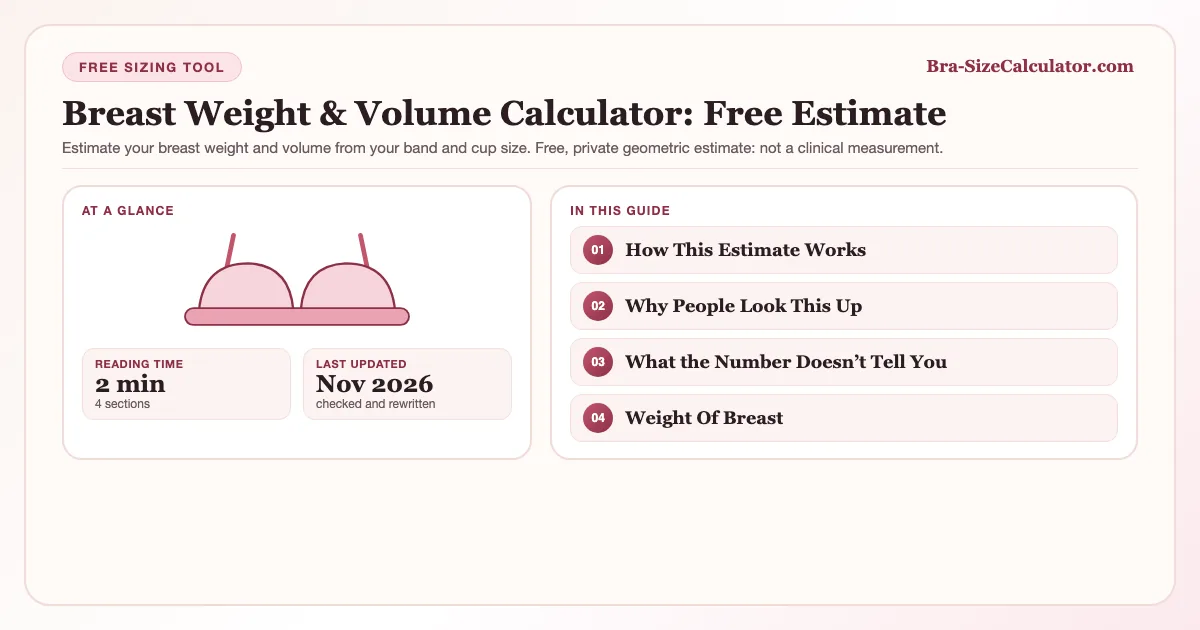
How This Estimate Works
There’s no way to weigh breast tissue without surgery, so every online calculator (including this one) works from geometry, not a scale. This tool treats each cup step as adding a roughly hemispherical volume of tissue, then multiplies that volume by an average tissue density of about 0.95 grams per cubic centimeter. Close to the density most published estimates use for a mix of fat and glandular tissue.
The result is a genuine order-of-magnitude estimate, not a clinical measurement. Real density varies from person to person. Someone with denser, less fatty tissue can weigh noticeably more than someone the same cup size with softer, fattier tissue.
Why People Look This Up
The most common reasons: curiosity after a size change, back and shoulder pain questions (heavier breasts pull harder on straps and shoulders), or simply wanting a number to compare against something like “how much does a bag of sugar weigh.”
What the Number Doesn’t Tell You
Weight alone doesn’t predict comfort. Band width, strap width, and how well a bra actually distributes that weight across your ribcage matter more than the raw number. Two people carrying the same estimated weight can have completely different comfort levels depending on their bra’s construction.
Weight Of Breast
Rotating between two or three well-fitted bras gives the power-mesh wing elastic twenty-four hours to rebound between wears.